The predator
that misses.
The best hook I made for this game did not come from the game. It came from footage nobody scrolls past, rebuilt from nothing in Blender.
Steal the attention, not the footage.
There is a whole genre of real video nobody scrolls past. A snow leopard dropping onto a mountain goat. An eagle taking a rabbit off a hillside. I had watched plenty of them myself, which was the point.
Search for one and the top of the results looks like this:
- Wild Miss! Snow Leopard Jumps at Mountain Goat5.1M
- Snow Leopard Ambush Fails! Ibex Escapes5.3M
- Himalayan Ibex45M
YouTube Shorts, view counts as checked. Go and look; that is the point of putting them here rather than describing them.
Nobody paid for any of that. No brief, no media buy, no agency. The attention structure is already proven at a sample size no advertiser can afford, and it keeps working across a hundred reuploads by people who did not shoot it.
So the question I asked was narrow: what do I lose if I build one of those from scratch in Blender, as game footage?
One thing. It is not real. Everything that made it work survives, and two things get added. Recognition, because a lot of people have half-seen the real version and know the shape of it before they know why. And control, because once the animals are ragdolls tied together in a physics sim, I can push the moment past anything a camera happened to catch.
The exaggeration is the whole craft, and it is a dial rather than a rule.
Everything happening in these ads is something the game actually does. You press to zoom, you find the animal, you release and it fires, a hit in the right organ drops it in one, animals go off rocks. None of that is invented.
What the game does not have is ragdoll. Shoot an animal off a ledge in the real build and it goes over like a log. In the ad it goes over tangled with the thing it was hunting, because I tied them together in a physics sim and let the weight do the acting.
The ad sells the same moment at a higher resolution than the game renders it.
That gap is where the dial sits. Push it and the creative gets better. Push it further and retention starts paying for it, because the install arrives expecting something the first session does not hand back.
I knew where that line was because I was lead game designer on this title: the game, its UI and its ads came off the same desk, so I was not guessing at what the build could return. Exaggerated, and still delivered. That is the only version of this that works twice.
One more thing every creative of mine that worked had in common, and I only noticed it afterwards: the shot is nearly made and missed. Not a clean kill. A near miss.
Then I went back and read the titles on the footage I had been borrowing from. Wild miss. Ambush fails.
The most watched version of a predator video is the one where the predator does not get it.
I had arrived at that from the ad side, by watching which of my creatives survived testing. It was sitting in the source material the whole time, written into the titles by people who were only trying to get clicks. Two different roads, same corner.
Four creatives from the set that tested around $0.15 CPI.
The one at the top of this page, and these three. All four are mine and all four are built, not captured. No gameplay recording, no stock: every frame is a Blender scene. I cannot tell you which one carried which number, because the studio was sold and the reporting went with it.
A narrow vertical rock face instead of the open ground the game is actually played on, so there is no sky, no horizon and nowhere for the frame to go empty. The cat takes the goat and both go over the edge, tied together in the sim so the weight does the acting.
This one shipped with a tiger. The version at the top of the page is the same creative recast with a black cat, and the two of them are the first test further down.
Open ground, but three species land in the scope together and each one gets its tier stacked under its name. The size of the offer is legible before a shot is fired, and a herd crossing frame does the rest.
The same creative as the one beside it. Same environment, same camera, same beats, same length. Two bears instead of three deer, and that is the entire difference.
Nothing, then everything, in under two seconds.
Four frames from three of them, at the same four moments. They all do the same thing, and none of them does the thing the category does.
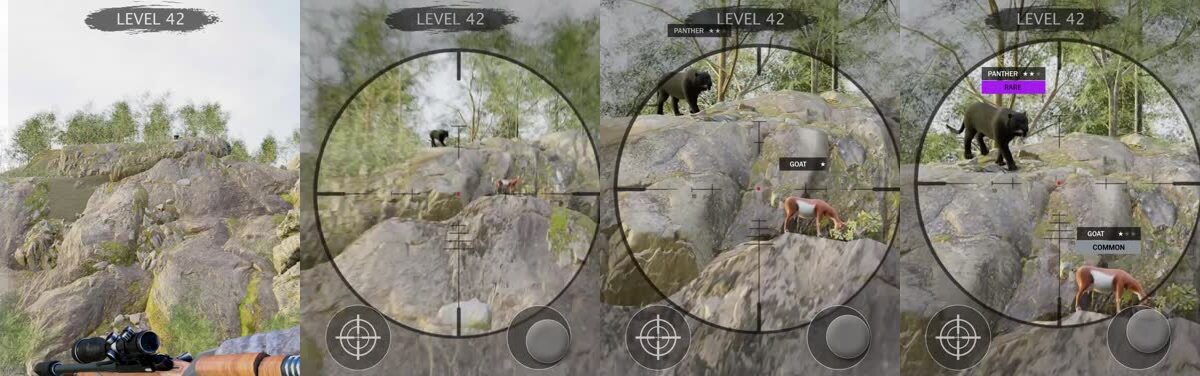
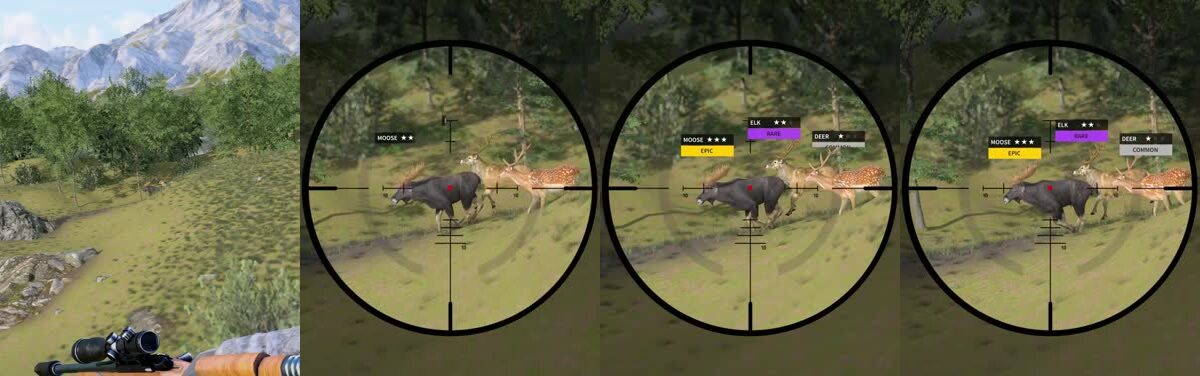
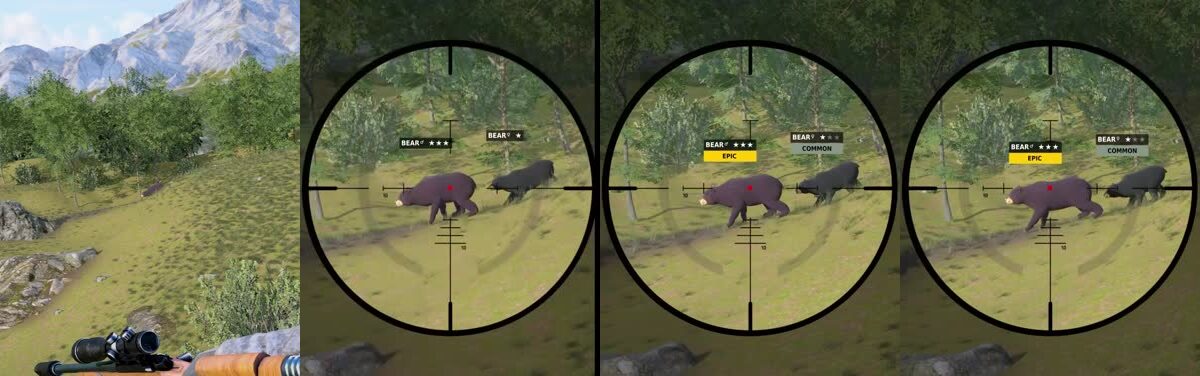
At zero you cannot see the target. Wide, unscoped, rifle low in frame, and whatever you are supposed to shoot is a speck on a ridge or a shape at the far end of a meadow.
At nine tenths of a second the scope is up and the thing has a name. At one point eight it has a price, the tier chip landing under the name: epic, rare, common.
The eye starts hunting before the character does.
Most ads in this category open on the kill, because the received wisdom is to lead with the payoff. These withhold it for about a second, and spend that second making you look for something. Then they resolve it and tell you what it was worth. Withhold, resolve, price, in the time it takes to decide whether to keep scrolling.
I would not claim this is why they worked. It is the one structural thing they share, and it is the part I built on purpose.
Three of them. Two winners and a failure.
Same game, same creatives, one thing moved at a time. I can explain one of these results, I cannot explain the second, and the third simply did not work.
Contrast · tiger, then black cat
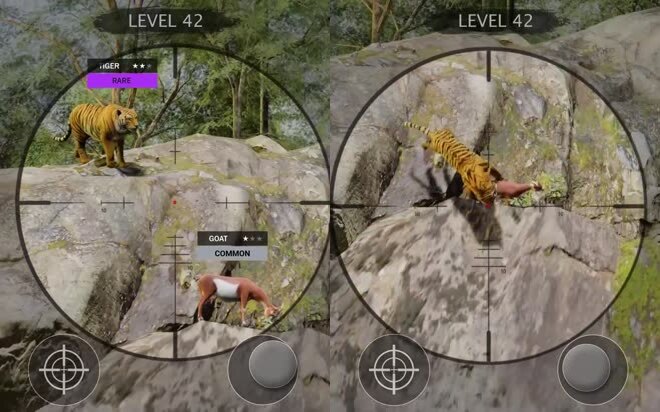
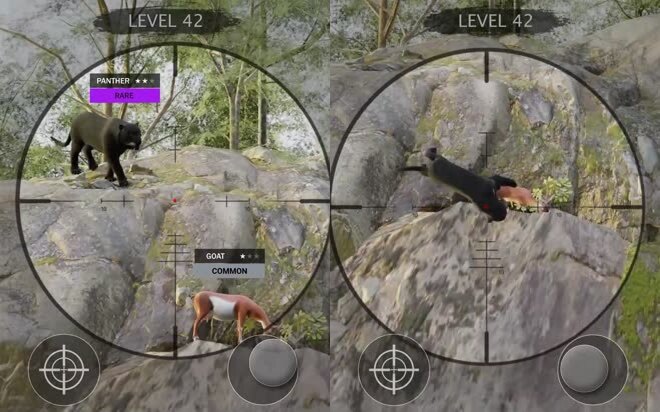
Both of these ran and both did well. The black one did better, and this is the rare case where I will say why.
At the size these are actually seen, a tiger is a pattern and a black cat is a shape. Stripes break up against mottled rock and foliage. A solid dark mass keeps its silhouette in a thumbnail, and keeps it again while it is rolling down a cliff with a goat in its mouth.
Subject · three deer, two bears
Four moments from each, at the same timestamps. Nothing moved except what is standing in the grass.
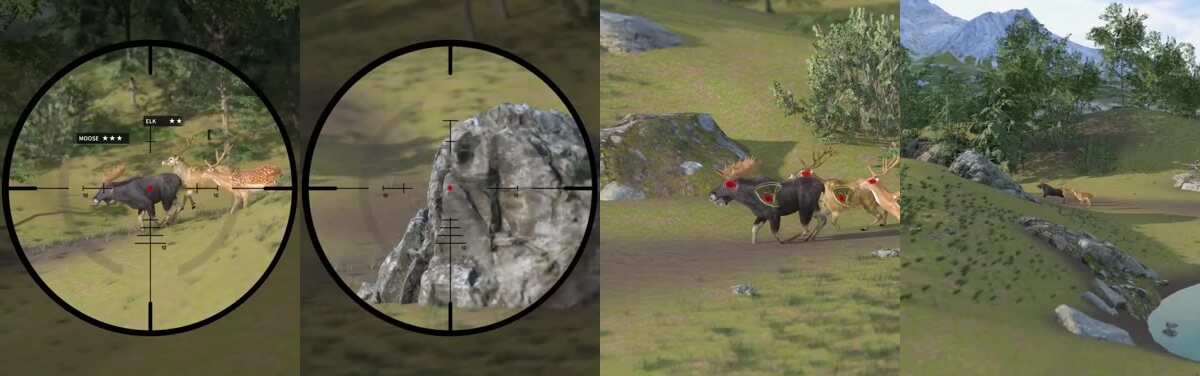
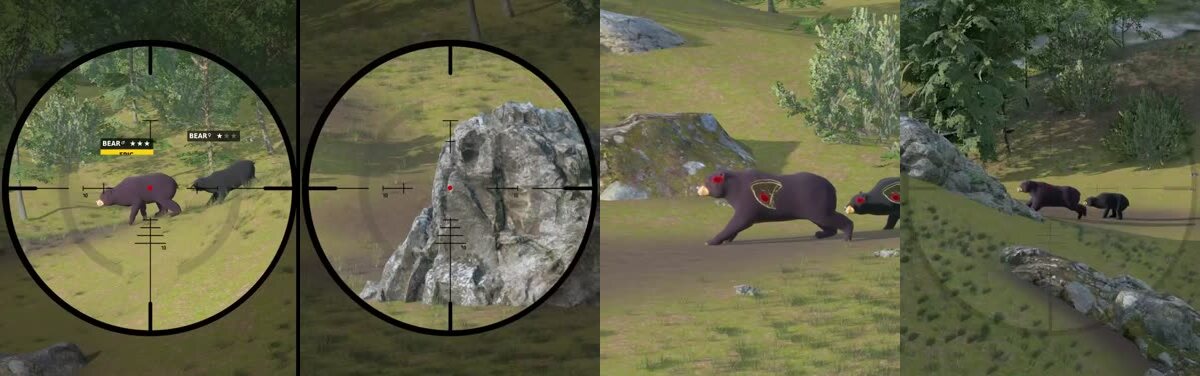
The deer version performed better. I do not know why. After enough of these I stopped inventing reasons, and I would rather hand you the result than a story about it.
The part I will defend is the shape of the test. The animal was the only thing that moved, so the animal is the answer, and the answer is readable at all. Most creative testing does not get that far, because most creative tests change four things and then argue about which one did it.
Environment · the snow version
We rebuilt the deer creative in a snow scene, for the same contrast reason that had worked on the rock face. It underperformed and we stopped running it.
My read is that someone tapping a hunting game has already pictured a green forest, and a snowfield is a different fantasy: executed correctly, aimed wrongly. I cannot prove that. What I can prove is that we dropped it, which is the only part of a failed test that has to be true.
Evo Games was sold and I lost access to the project files, so what survives is what I had already downloaded. Everything on this page is my own work, and only my own work.
Where I do not have the number, I have said so rather than filled it in. If a claim here matters to you, ask, and I will tell you exactly how much of it I can back.